
Why Is Sugar Syrup Filtration Important?
Why Is Sugar syrup filtration Important?
sugar syrup filtration is a quiet control point in modern sugar production. It removes suspended solids, carbon particles, scale, and other visible impurities before evaporation, crystallization, or filling. Without effective filtration, a syrup stream can carry small particles into heated equipment. Those particles may darken the product, damage valves, or create unwanted deposits on heat-transfer surfaces.
It protects consistency.
Sugar technologist Peter Rein has stated, “Filtration is not merely polishing; it protects every stage that follows.” This principle reflects practical factory experience. A clear syrup can pass through pipes more smoothly and reduce blockages around pumps, screens, and nozzles. It can also support a more stable color and cleaner crystal formation. Operators usually monitor pressure differences across the filter. A rising pressure reading often signals loading, poor cleaning, or an unsuitable filter medium.
The details matter. A filter that removes too little material cannot protect downstream equipment. A filter that is too fine may reduce flow and increase operating costs. Temperature also changes syrup viscosity, so filtration performance should be evaluated under real process conditions. Sampling before and after filtration gives useful evidence, especially when turbidity or color varies between production batches.
Still, filtration is not a complete solution. It cannot correct every chemical imbalance or replace good sanitation. I have seen process discussions focus heavily on filter ratings while overlooking cleaning routines and syrup temperature. That is a weakness worth admitting. Reliable sugar syrup filtration combines suitable equipment, trained operators, documented checks, and honest review of results. Small improvements can become visible in every clear tank, clean pipe, and consistent batch.
What Is Sugar Syrup Filtration?
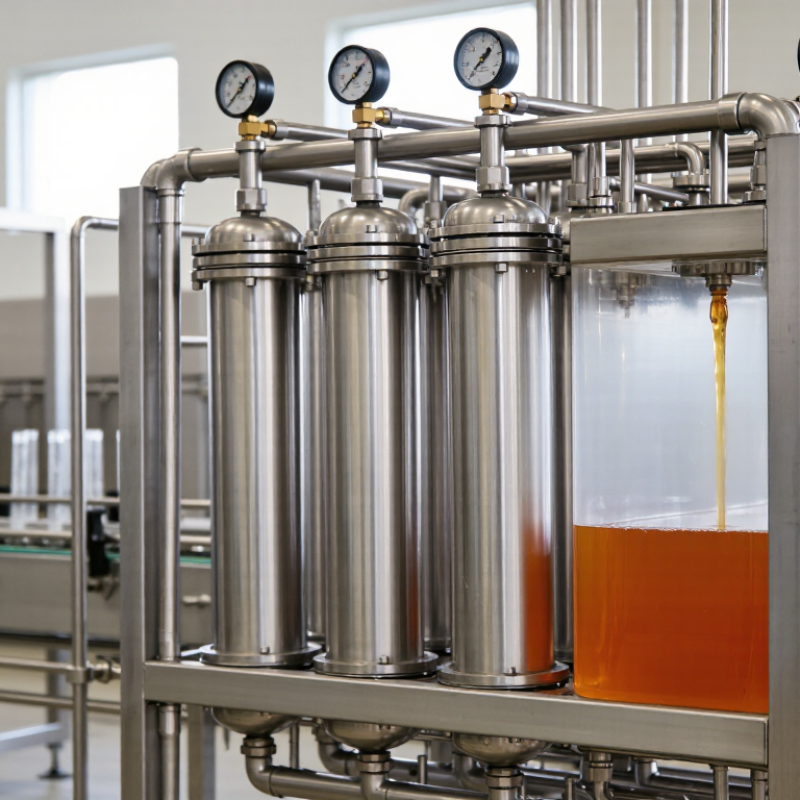
Sugar syrup filtration is the controlled removal of unwanted solid particles from dissolved sugar and water. These particles may include fibers, crystallized sugar, dust, or fragments from processing equipment. The syrup passes through a filter medium while pressure moves the liquid forward. The filtered syrup then continues to cooking, filling, or another production stage.
In practical production, operators select filter materials according to syrup temperature, viscosity, and expected particle size. A coarse screen may capture larger debris, while a finer cartridge can remove smaller suspended matter. Clear sight glasses help workers inspect the flow. Differential pressure readings also show when a filter is becoming blocked. Small details matter. Warm syrup flows more easily, but excessive heat can affect color and quality.
Filtration improves visual clarity and protects pumps, valves, and filling equipment. It can also reduce uneven deposits inside storage tanks. However, filtration is not a complete purification step. It usually cannot remove dissolved sugar, all color compounds, or every microorganism. Filter changes, sanitation, and inspection still require disciplined control. A poorly fitted seal may allow particles to bypass the filter. That weakness is easy to overlook. Testing turbidity, checking pressure records, and reviewing cleaning procedures provide more reliable evidence than appearance alone. Human judgment remains important, and the process may need adjustment when syrup behavior changes.
Why Is Sugar Syrup Filtration Important? - What Is Sugar Syrup Filtration?
| Data Dimension | What It Means | Typical Information | Why It Matters |
|---|---|---|---|
| Definition | Sugar syrup filtration | The controlled removal of suspended particles and insoluble impurities from a sugar-and-water solution. | It produces a cleaner, more uniform syrup before storage, processing, or filling. |
| Main contaminants | Physical impurities | Undissolved sugar crystals, fibers, dust, scale particles, rust, and other suspended solids. | Removing these particles helps protect pumps, valves, heat exchangers, and filling equipment. |
| Clarity | Visual cleanliness of the syrup | Fine filtration can reduce visible haze and suspended matter; the required clarity depends on the application. | Clearer syrup supports a more consistent appearance in beverages, confectionery, bakery products, and other foods. |
| Filter selection | Choice of filtration equipment and media | Common options include screens, bag filters, cartridge filters, and depth-filtration systems. | The filter must match syrup viscosity, temperature, flow rate, solids loading, and required cleanliness. |
| Filtration rating | Particle-retention capability | Filter ratings are commonly expressed in micrometres (µm); coarser prefilters are often followed by finer filters when needed. | A staged approach can extend filter life and reduce premature clogging. |
| Temperature | Syrup temperature during filtration | Heating generally lowers viscosity, while excessive heat can increase energy use and may affect product quality. | Maintaining a suitable process temperature helps achieve stable flow and effective particle removal. |
| Viscosity | Resistance to flow | Sugar syrup becomes more viscous as dissolved-solids concentration increases and temperature decreases. | Higher viscosity can reduce flow rate and increase pressure drop across the filter. |
| Pressure drop | Pressure difference across the filter | A rising pressure differential commonly indicates increasing particle loading or filter blockage. | Monitoring pressure helps determine when cleaning or filter replacement is required. |
| Food safety | Hygienic control of the process | Filtration removes physical particles but does not replace validated heat treatment, sanitation, or microbiological controls. | It is one supporting step within a broader food-safety and sanitation program. |
| Product consistency | Uniformity between production batches | A consistent filtration process helps control the amount of suspended material entering downstream operations. | Improved consistency supports predictable color, texture, appearance, and equipment performance. |
| Filter maintenance | Cleaning, inspection, and replacement | Maintenance intervals depend on syrup solids, particle load, operating temperature, flow rate, and filter design. | Regular maintenance reduces contamination risks, unplanned downtime, and unstable flow. |
| Best-practice sequence | Typical process arrangement | Dissolution → coarse screening or prefiltration → finer filtration when required → quality inspection → hygienic storage or transfer. | A suitable sequence balances clarity, throughput, operating cost, and protection of downstream equipment. |
Note: Actual filter ratings, temperatures, flow rates, and maintenance intervals should be established through process validation and the requirements of the specific syrup application.