
Top 10 Spiral Slide Manufacturers for Global Buyers
Choosing a Spiral Slide manufacturer is not just a price comparison. A slide may look simple in a catalogue, yet its design affects play value, installation, maintenance, and long-term performance. Global buyers also face practical differences in climate, shipping distance, project scale, and local site requirements. Small details matter: the platform height, the curve’s shape, the finish beneath a child’s hands, and how easily crews can inspect connections.
Playground researcher Dr. Joe L. Frost is often associated with the phrase, “Play is the business of childhood.” That idea offers useful context for evaluating manufacturers. A strong supplier should consider how children actually use a slide, not only how it photographs. Buyers can compare materials, design options, customization, quality documentation, project support, and the clarity of warranty terms. Ask for evidence, not polished claims alone.
This Top 10 guide is designed to help buyers make those comparisons with care. It highlights manufacturers serving different markets and project needs, while recognizing that no single supplier fits every site. A product suited to a compact indoor play area may not be right for a large outdoor park. And specifications on paper do not tell the whole story. Review project references, confirm details directly with suppliers, and consider how installation and upkeep will work at your location. A little uncertainty remains until those checks are complete. That is worth acknowledging.
Understanding Spiral Slides and Their Role in Play Environments
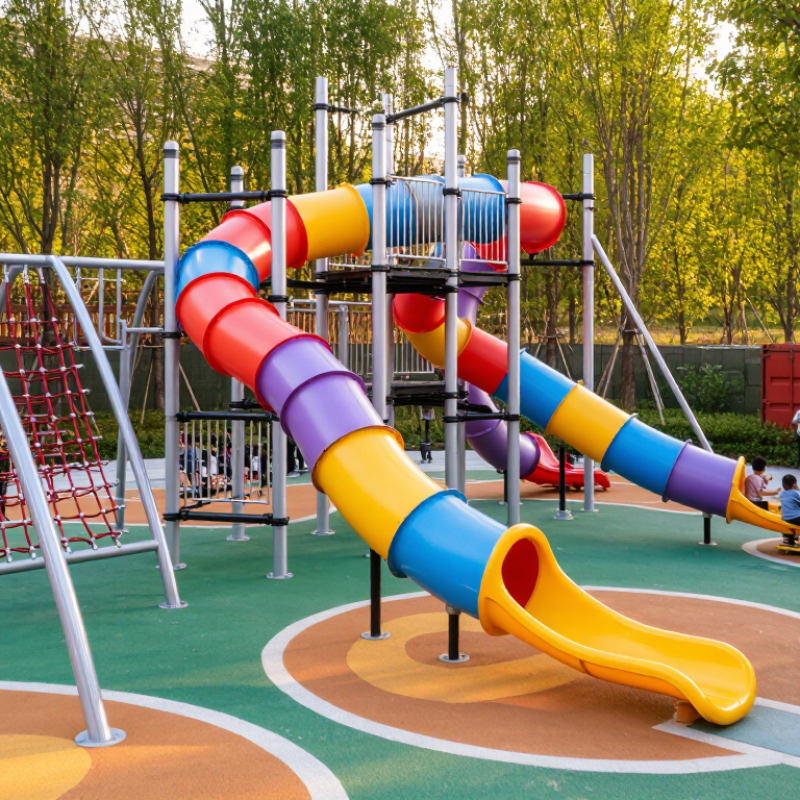
A spiral slide changes more than the way a child reaches the ground. Its curved path slows the descent, creates anticipation, and can make a compact play area feel more varied. The shape also affects supervision: a tall, enclosed curve may hide a child from view for several seconds. Designers should consider the slide’s entry platform, nearby climbing routes, and landing space as one connected play sequence. Small details matter. A clear exit helps prevent children from meeting someone still using the slide.
Safety planning depends on measured space, not appearance alone. The U.S. Consumer Product Safety Commission’s Public Playground Safety Handbook (2015) generally recommends a six-foot use zone around stationary equipment, subject to specific exceptions and layout rules. Its guidance also stresses impact-attenuating surfacing beneath and around equipment, selected for the equipment’s fall height. These figures are useful starting points, not a substitute for checking the actual layout and applicable standards. A spiral slide can look orderly on a plan, yet crowd a path once children gather around it. Designers can misjudge that flow. Children rarely follow neat arrows. Clear sightlines, suitable surfacing, and an unobstructed exit make the experience more comfortable for caregivers and young users.
Top 10 Spiral Slide Manufacturers for Global Buyers - Understanding Spiral Slides and Their Role in Play Environments
Use this brand-neutral comparison checklist to evaluate manufacturers. It focuses on verifiable capabilities and project requirements rather than ranking or naming companies.
| No. | Manufacturer capability to assess | What buyers should verify | Why it matters for spiral slides |
|---|---|---|---|
| 1 | Safety-standard documentation | Ask which standards apply to the project and request relevant design, inspection, or conformity documentation. Common references include ASTM F1487 in the United States and EN 1176 in Europe; applicability depends on jurisdiction and project scope. | Slide geometry, access points, exits, and surrounding use zones must be considered as part of the complete playground installation. |
| 2 | Age and user-group planning | Confirm the intended age group, access method, platform height, and any project-specific accessibility requirements. | The appropriate slide configuration depends on the users and the design of the surrounding play equipment. |
| 3 | Material and finish options | Request the material specification, finish details, cleaning guidance, and suitability information for the intended climate and site conditions. | Spiral slides may use different construction materials, including metal or molded plastics; each option has distinct maintenance and site considerations. |
| 4 | Configuration and site fit | Request dimensioned drawings showing slide height, footprint, entry and exit orientation, support locations, and required clearances. | A curved slide can occupy a different footprint from a straight slide, so layout and circulation should be checked before ordering. |
| 5 | Engineering and installation information | Check that the supplier provides assembly instructions, connection details, anchoring requirements, and installation drawings for the specified model. | Correct assembly and attachment to the supporting structure are essential parts of a complete installation. |
| 6 | Fall-zone and surfacing coordination | Request the equipment layout and confirm that the project team will verify use zones and impact-attenuating surfacing against applicable local requirements. | A slide should be planned together with adjacent equipment, circulation paths, and the playground surface. |
| 7 | Quality control and traceability | Ask how products are inspected, how components are identified, and what product-specific quality records are supplied. | Clear records make it easier for buyers and installers to confirm that delivered parts match the approved design. |
| 8 | Maintenance and replacement parts | Confirm inspection guidance, cleaning recommendations, warranty terms, and the availability and identification of replacement components. | Ongoing inspection and maintenance help operators manage playground equipment throughout its service life. |
| 9 | Export and logistics readiness | For international projects, confirm packing dimensions, shipping method, delivery terms, documentation, and responsibility for import requirements. | Spiral components can be bulky, making shipping plans and site access important parts of procurement. |
| 10 | Project communication and support | Evaluate response times, drawing revisions, language support, installation assistance, and the process for resolving delivery or product issues. | Coordinated technical communication can help reduce misunderstandings between the buyer, designer, installer, and supplier. |
Note: Standards, regulations, and project requirements vary by country and installation. Buyers should confirm current local requirements with qualified playground professionals and the relevant authorities.