Who Are the Top Robotic Pool Cleaner Manufacturers in China?
China’s pool-care industry has grown alongside demand for convenient, consistent cleaning. A Robotic Pool Cleaner can reduce hands-on work, but value depends on more than suction or a polished product photo. Buyers should look closely at navigation, filtration, cable management, energy use, warranty support, and performance across different pool shapes. Small details matter. A cleaner that struggles with steps or fine debris may disappoint, even when its specifications appear impressive.
This guide compares Chinese manufacturers using practical, verifiable signals: engineering focus, production capability, export support, and documented quality standards. It also distinguishes brands from factories and trading companies, since these roles can affect customization, communication, and after-sales service. No list is perfect. Public information varies. Check claims against current product documents, independent tests where available, and direct supplier discussions. The manufacturers discussed here are starting points, not automatic recommendations. Compare models against your pool size, surface, debris conditions, and service expectations before making a decision. The right choice is rarely the loudest claim; it is the one supported by evidence and suited to the job. Some details may remain unclear until a buyer asks specific questions. That is worth admitting.
What Defines a Robotic Pool Cleaner Manufacturer?
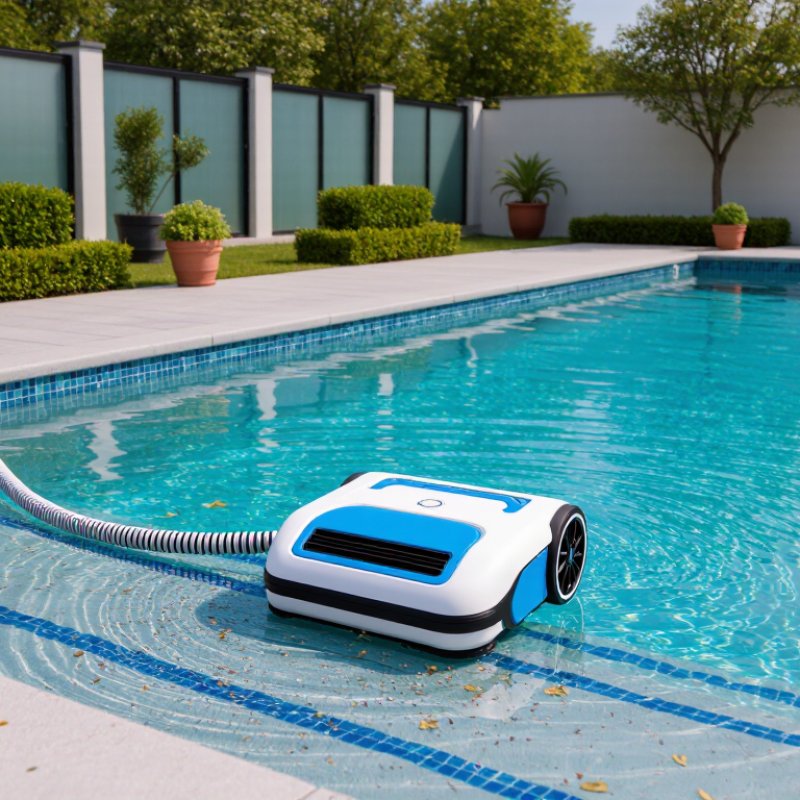
A robotic pool cleaner manufacturer does more than assemble a motor, wheels, brushes, and a plastic shell. It develops or carefully specifies how these parts work together in water. Look for clear engineering records, consistent component sourcing, and staff who can explain how the cleaner handles steps, corners, and different pool surfaces. Practical knowledge shows in details: brush wear, cable strain, filter access, and whether the unit can climb a damp wall without slipping.
Testing should resemble real use, not just a brief run in a clean tank. A capable manufacturer checks movement, suction, water sealing, and filtration across repeated cycles. Ask how it records failures and verifies repairs. No production line is flawless. A weak seal may still escape detection, so honest test data and traceable quality checks matter more than polished claims. Details count.
Manufacturing depth also includes stable production capacity, clear technical documents, and access to replacement parts. Buyers can review sample units, inspect assembly and testing procedures, and ask who handles design changes. A supplier that only follows drawings may offer less control than one with in-house engineering, though in-house capability alone proves little. Compare evidence, response quality, and service commitments. Some questions will remain unanswered; that is a reason to investigate further, not to assume the best.
How China’s Robotic Pool Cleaner Industry Developed
China’s robotic pool cleaner industry grew from a broader base in appliance and electronics manufacturing. Over time, factories developed experience with compact motors, sealed housings, pumps, and filtration parts. These components matter in a wet, chemically treated environment. Small design choices can affect reliability.
A practical shift. Manufacturers moved beyond assembling imported-style components and began refining complete cleaning systems. Better battery control and sensor integration helped cordless models navigate pool floors and walls. Meanwhile, established supply networks made it easier to source cables, brushes, filters, and molded parts. Progress has not been perfectly linear; early navigation could be inconsistent around steps and curved corners.
Export demand also encouraged closer attention to testing, product documentation, and feedback from overseas distributors. Engineering teams now often adjust cleaning patterns, filter access, and charging arrangements for different pool shapes and user habits. Yet strong production capacity does not automatically mean strong field performance. A cleaner may work well in a test tank but struggle with leaves, fine dust, or uneven surfaces. That gap still deserves honest scrutiny. Industry development continues through repeated design changes, durability checks, and practical feedback from real pools.
China’s Robotic Pool Cleaner Industry: Digital Adoption as an Enabler
As internet access expanded in China, manufacturers gained a stronger foundation for connected product features and digital services. This chart shows internet use among China’s population—not robotic pool cleaner sales or industry size.
Source: World Bank, Individuals using the Internet (% of population), China. View data.
Criteria for Identifying Leading Manufacturers
A leading robotic pool cleaner manufacturer should show more than an attractive prototype. Look for engineering records, repeatable production checks, and test results tied to specific models. Ask how cleaners perform in pools with steps, curved walls, and fine debris. A glossy demonstration is not enough. Useful evidence includes measured cleaning coverage, runtime, filtration performance, and tests repeated across multiple units. Check whether reports come from an independent laboratory or the manufacturer’s own facility, and ask how test conditions were recorded. If answers stay vague, that matters.
Materials and support deserve equal attention. Chlorinated water, sunlight, and repeated handling can wear down seals, cable jackets, and plastic housings. Ask about material testing, repair procedures, spare-part availability, and warranty handling. Confirm that relevant safety and quality certifications are current and verifiable for the intended market; a certificate should match the product, not just the factory. Review production capacity and traceability, too. Can the manufacturer identify a unit’s batch and inspect it before shipment? Speak with existing buyers when possible, but treat testimonials cautiously. I would not judge a supplier by one successful sample alone; that may be too strict, yet consistency is what buyers need.
Profiles of Leading Robotic Pool Cleaner Manufacturers in China
Profiles of leading robotic pool-cleaner manufacturers in China are easier to compare by capability than by sales claims. Some factories focus on OEM and ODM production, adapting brush layouts, filters, and control panels for buyers. Others emphasize in-house engineering, testing navigation, wall climbing, and debris pickup across different pool shapes. Component-integrated manufacturers may produce motors, battery packs, or control systems internally, giving them closer control over assembly. Small details matter.
Industry context is useful, but it needs careful reading. The International Federation of Robotics’ World Robotics 2024 report says China installed 276,288 industrial robots in 2023, or 51% of global installations. This indicates a strong automation base; it does not rank pool-cleaner manufacturers or prove product quality. For a practical profile, check factory audits, water-ingress test records, replacement-part availability, and documented cleaning tests. A polished demo is not enough. I would also ask how performance changes when the filter basket fills, since that detail is easy to overlook.
Tips: Request test results for fine dust, leaves, and wall cleaning, plus clear warranty and spare-part terms. Ask for evidence.
How Chinese Manufacturers Compare in Products and Technology
Chinese robotic pool cleaner manufacturers differ less by headline suction figures than by how well their systems handle real pool conditions. According to the International Federation of Robotics’ World Robotics 2024 report, China installed 276,288 industrial robots in 2023, about 51% of global installations. This signals a substantial automation base, but it does not measure pool-cleaner quality directly. Buyers should compare practical details: floor, wall, and waterline coverage; filter capacity; cable or battery design; and the ability to navigate around steps. Small details matter. A cleaner that repeatedly misses a shaded corner may be less useful than one with a lower advertised speed.
Technology also varies in how products sense and respond to a pool. Some use programmed routes and inertial sensors; others add obstacle detection or adaptive path planning. In a rectangular test pool, consistent wall climbing and fewer missed strips are easy to observe. In an irregular pool, results can change. The UNIDO report Industrial Development Report 2024 discusses China’s broad manufacturing capabilities, but it does not rank robotic pool-cleaner makers or verify their performance claims. That distinction is important. Specifications are not independent test results. Ask for runtime and filtration data under stated conditions, and check whether performance has been tested with leaves, fine dust, or both. I would still want clearer, comparable testing across pool shapes.