
How to Choose a Patterned Children Play Mat for Buyers

A Patterned Children Play Mat can brighten a nursery, but buyers should judge more than its colors. The World Health Organization’s 2019 guidelines recommend that infants have interactive floor-based play several times a day, including supervised tummy time while awake. This makes the mat’s usable surface, cushioning, and ease of cleaning practical considerations, not just design details. Details matter.

Safety deserves equal attention. The U.S. Consumer Product Safety Commission’s 2022 toy-related injury report estimated 209,500 emergency department visits involving toy-related injuries among children under 15 in the United States. The report does not identify play mats as the cause, so the figure should not be treated as mat-specific evidence. Still, it underscores why buyers should check age guidance, material information, and available product test documentation rather than relying on attractive packaging.

A useful selection process compares pattern clarity, print durability, edge finishing, grip on the intended floor, thickness, dimensions, and cleaning instructions. For example, a vivid animal print may photograph well, yet become hard to inspect when toys cover it. Ask suppliers how colors are applied, what testing supports their safety claims, and how the mat performs after repeated cleaning. Requirements can differ by destination market, so documentation matters. No checklist removes every uncertainty; even a well-reviewed product may not suit every home. Buyers should weigh verified specifications against the child’s age, play space, and daily routine.
How to Choose a Patterned Children Play Mat for Buyers

Identify the Child’s Age, Play Setting, and Applicable ASTM F963 Requirements

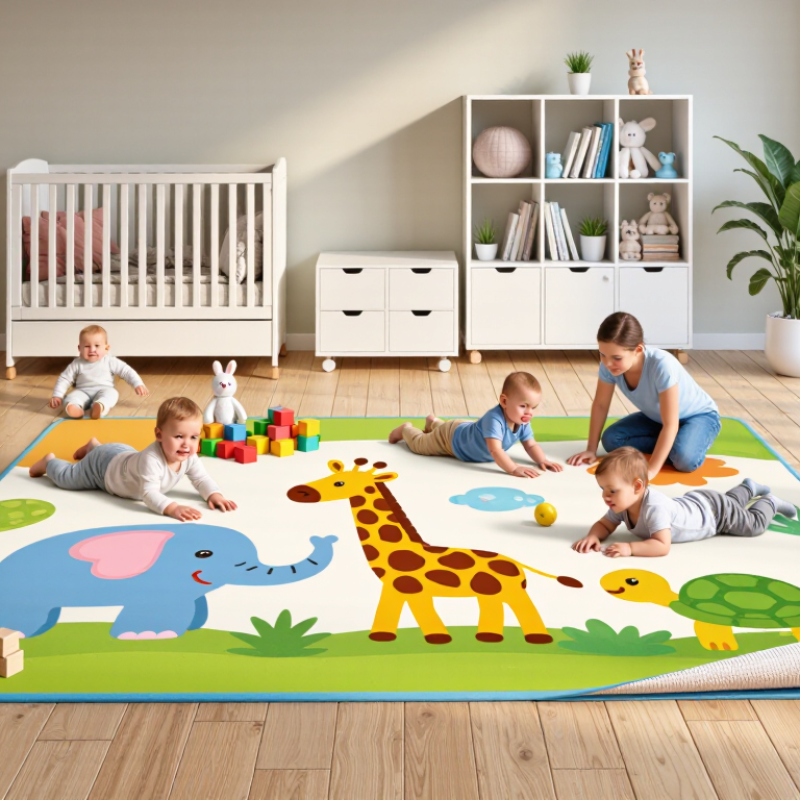
Before comparing patterns, define who will use the mat and where it will sit. A baby who is still mouthing objects needs a smooth, wipeable surface without loose appliqués or easy-to-peel decorations. For a toddler, check whether edges curl when little feet run across them. A quiet play corner, a tiled kitchen floor, and a daycare room create different needs. Measure the space, then consider whether the mat can be cleaned and dried between uses. Patterns can hide crumbs. They can also make small toys harder to spot.

For buyers serving the US market, confirm whether the mat is classified or marketed as a children’s toy. ASTM F963 applies to toys, but its relevance depends on the product’s intended use and classification. Ask suppliers which current requirements and test methods apply to this specific mat, and review supporting test reports or conformity documents. Don’t rely on a generic “meets safety standards” statement. Check the stated age grade, warnings, material details, and any detachable parts. Requirements can vary with design and intended age.

A paper checklist helps. Real use is messier. Look at seams, printed areas, and corners after repeated folding or cleaning; a pretty sample may not reveal wear. Match the pattern’s contrast to the play setting, too. Busy graphics can distract some young children, while pale designs show stains quickly. Age labels guide selection, but they cannot predict every child’s behavior.
Check CPSIA Limits: 100 ppm Lead and 0.1% Phthalates for Covered Products

How to Choose a Patterned Children Play Mat for Buyers

A playful print can make a mat inviting, but check what sits beneath the colors. For children’s products covered by CPSIA rules, lead is limited to 100 ppm in accessible component parts. Certain covered products also have a 0.1% limit for specified phthalates in relevant components. A play mat’s exact requirements depend on how it is classified and which materials it contains. Printed layers, soft backing, and plasticized sections may need separate attention.

Ask the supplier for test reports tied to the exact mat, not just a similar design. Check that the report names the materials tested and clearly identifies the applicable lead and phthalate limits. Testing may not cover a later change in ink, backing, or production batch. A tidy document helps, but it does not answer every question. I would pause if the report is vague or cannot be matched to the product.

Tips: Request current, product-specific test documentation and ask which components were tested. Compare the report with the mat’s actual colors and construction. If a key detail is missing, ask before buying. Small print can hide big differences.

How to Choose a Patterned Children Play Mat for Buyers — Check CPSIA Limits: 100 ppm Lead and 0.1% Phthalates for Covered Products
Buying dimension Relevant benchmark or specification What buyers should verify
Lead in accessible components For covered children’s products, the CPSIA total lead limit is 100 ppm (0.01%) in accessible component parts. Request applicable test documentation for accessible materials, such as the mat surface, printed pattern, and any reachable trim or fasteners.
Lead in paint or surface coatings The federal limit for lead in paint and similar surface coatings is 90 ppm (0.009%). Ask whether colored or printed surface layers were assessed as coatings where the requirement applies. Do not treat the 100 ppm component limit as a substitute for the coating limit.
Restricted phthalates For covered children’s toys and child care articles, each of eight specified phthalates is limited to 0.1% (1,000 ppm) in accessible component parts. Check that documentation identifies the tested material and addresses DEHP, DBP, BBP, DINP, DIBP, DPENP, DHEXP, and DCHP, as applicable.
Product classification CPSIA requirements depend on whether the item is a covered children’s product, toy, or child care article, including its intended use and design. Confirm the product’s age grading, intended use, and applicable requirements with the responsible manufacturer or importer. A play mat is not automatically subject to every toy-specific rule.
Testing and certification Applicable children’s product requirements may require testing by a CPSC-accepted third-party laboratory and a Children’s Product Certificate (CPC). For covered products, request the CPC and supporting test reports. Check that the reports match the product materials, colors, and construction being purchased.
Pattern inks and printed layers Printed designs can contain separate inks, coatings, or laminated layers; applicable chemical limits are assessed against the relevant accessible materials. Ask whether testing covers the actual printed or colored components, not only an unprinted base-material sample.
Mat dimensions and coverage There is no single CPSIA-mandated play-mat size. Dimensions should match the buyer’s intended floor area and use. Compare the stated length and width with the available space. Confirm whether listed dimensions refer to the mat itself and whether multiple pieces or edge sections are included.
Thickness and surface construction There is no universal CPSIA thickness requirement for children’s play mats. Request the stated thickness and material construction. Check product information for seams, layered surfaces, and any care or use limitations.
Pattern legibility and color consistency Pattern quality is a purchasing specification rather than a CPSIA chemical limit. Review a production sample or clear photographs for readable graphics, consistent printing, and visible peeling, cracking, or transfer of the design.
Documentation and traceability Children’s product certificates identify the product and applicable rules and provide manufacturer or importer and testing information. Match product identifiers, material descriptions, and report dates to the goods being ordered; retain the records with purchase and quality documentation.
Regulatory source CPSIA lead and phthalate provisions are administered by the U.S. Consumer Product Safety Commission (CPSC). Confirm current requirements and product-specific applicability with official CPSC guidance or qualified compliance support before placing an order.

Compare Foam and Textile Mats by Thickness, Density, and Material Disclosure

When choosing a patterned children’s play mat, look beyond the printed design. Thickness affects cushioning, but a thicker mat is not automatically safer or more supportive. Check the product’s stated thickness and consider where it will sit: a firm floor, carpet, or a play area with low furniture nearby. Small differences can matter when a crawling child shifts weight or a toddler takes an uneven step.

Foam mats are often lightweight and easy to wipe clean. Their density matters too: low-density foam may compress quickly under knees or furniture, while denser foam can feel firmer and hold its shape longer. Textile mats may offer a softer, familiar surface, but their comfort depends on the filling and construction. Look for information on layer thickness, filling type, washable parts, and whether the mat has a nonslip backing. The pattern tells you little about performance.

Read material disclosures carefully. Useful listings identify the surface fabric, inner foam or padding, and any coating, rather than relying on vague terms such as “soft” or “non-toxic.” Ask for documentation if key details are missing. That takes a moment. I still find thickness comparisons frustrating when sellers measure compressed and uncompressed products differently. Compare measurements only when the method is clear, and inspect seams, edges, and labels on arrival. A pleasant print cannot make up for unclear specifications.

How to Choose a Patterned Children’s Play Mat

Compare foam and textile mats by checking thickness, density, and material disclosure. The chart is a density-unit conversion reference, not a set of product specifications or typical market values.

Buyer tip: Compare thickness in millimetres and density in the same units; 1 g/cm³ equals 1,000 kg/m³. Ask for the exact material composition rather than relying on terms such as “foam” or “fabric.” A patterned cover or print does not identify the mat’s underlying materials.

Assess Pattern Durability, Colorfastness, and Cleaning Requirements

How to Choose a Patterned Children Play Mat for Buyers

A lively print can hide small crumbs, but it may also show fading or scuffing over time. Check how the pattern is made, not just how bright it looks in a product photo. Printed designs sit on the surface and can wear with frequent rubbing. Inlaid or textured patterns may hold their appearance longer, though seams and grooves can collect dirt. Ask for close-up images or a sample when possible. Look for clear edges and consistent color.

Colorfastness matters when spills and damp cleaning are part of daily use. Test a sample by pressing it with a clean, slightly damp white cloth; visible color transfer is a warning sign, not a full laboratory test. Follow the maker’s care label, since some finishes tolerate mild soap while others need only a damp wipe. Avoid assuming every mat can go in a washing machine. Dry it fully before children use it again. Small detail.

A patterned mat will not stay pristine forever. That is worth admitting. Choose a design where ordinary wear is less noticeable, and check that the surface still looks even after cleaning. If a patch becomes sticky, cracked, or difficult to wipe, appearance is no longer the only concern. Inspect it regularly.

Verify Mat Dimensions, Slip Resistance, and Supplier Test Documentation

How to Choose a Patterned Children Play Mat for Buyers

Measure the usable play area, not just the mat’s printed dimensions. Ask for length and width after unpacking, plus thickness under light pressure. A curled edge can reduce the safe, usable space. Check that the mat fits without blocking doors or leaving narrow gaps beside furniture. Small details matter. Patterned surfaces can also hide seams, so inspect product photos and samples closely.

Slip resistance needs evidence, not a vague “non-slip” claim. Request test results that identify the method, floor surface, test conditions, and product version. A result on dry concrete may not predict performance on polished tile. I may be overcautious, but I would also ask whether the report covers the exact mat construction being offered. The U.S. Consumer Product Safety Commission’s 2023 toy-injury report estimated 231,700 emergency-department-treated toy-related injuries among children aged 14 and younger; it does not isolate play mats, but it shows why product checks deserve care. Request dated reports from a competent testing laboratory, and confirm that the supplier’s product code matches the report. If documentation is incomplete, pause. A neat certificate can still leave questions.

Call Now Button