
China Top 10 Atomized Metal Powder Manufacturers?
China’s Atomized Metal Powder industry serves demanding sectors, including aerospace, additive manufacturing, automotive, tooling, and medical engineering. This guide introduces ten manufacturers worth evaluating when sourcing Atomized Metal Powder from China. It focuses on practical evidence, not promotional rankings. Manufacturing capability, process consistency, and technical communication matter more than attractive product photographs.
The review considers gas and water atomization, alloy selection, particle-size distribution, morphology, oxygen content, and batch traceability. These details influence powder flow, packing density, sintering behavior, and printing stability. A reliable supplier should provide current test reports, production records, inspection procedures, and samples matched to your application. Details matter. Small differences in satellite particles or moisture can affect an entire production run.
Where possible, buyers should compare certifications, laboratory equipment, delivery performance, and customer feedback from relevant industries. A polished website proves little. Direct factory communication, sample testing, and an independent inspection offer stronger evidence. Some manufacturers may appear technically impressive but provide limited data. That deserves caution.
The companies discussed here are not identical. Some specialize in stainless steel or tool steel, while others focus on titanium, aluminum, nickel-based, or copper alloys. Their strengths may also change with equipment upgrades, management decisions, and market conditions. No list is permanent. Readers should verify specifications before signing a contract, especially for regulated or safety-critical applications. This introduction is designed to support a clearer comparison, while recognizing one limitation: public information rarely reveals every production risk. Practical evaluation remains essential.
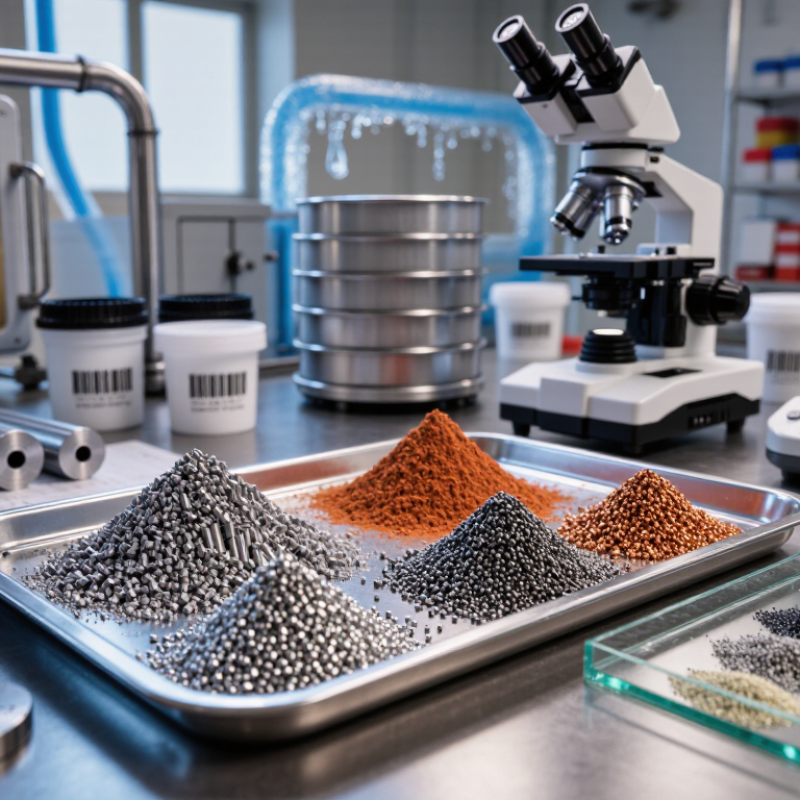
What Is Atomized Metal Powder and Where Is It Used?
Atomized metal powder is produced by breaking molten metal into fine droplets with gas or water. Each droplet cools into a separate particle. Gas atomization usually creates cleaner, more spherical powders, while water atomization often produces irregular shapes. Particle size, oxygen level, flowability, and density affect performance.
These powders support metal injection molding, additive manufacturing, thermal spraying, and powder metallurgy. Stainless steel powder can form complex medical or industrial components. Aluminum powder helps create lightweight parts. Nickel and cobalt alloys are useful where heat and corrosion resistance matter. In practice, the best powder is not always the finest one. A smaller particle may improve detail but reduce flow and increase handling concerns.
Tips: Check the particle-size distribution, not only the average size. Ask for test reports covering chemistry, oxygen, moisture, and apparent density. Confirm whether the powder matches your printer, mold, or sintering process. Storage also matters; sealed containers and dry conditions help protect consistency. A supplier’s equipment and quality controls deserve close review. I have found that batch variation can matter more than a polished specification sheet. That point is easy to underestimate. For a reliable comparison of the top ten manufacturers, examine traceability, production capacity, inspection methods, and technical support rather than relying on rankings alone.
| No. | Atomized Powder Category | Common Atomization Method | Typical Particle Size | Typical Particle Shape | Key Material Characteristics | Representative Applications | Common Quality References |
|---|---|---|---|---|---|---|---|
| 1 | Iron and Low-Alloy Steel Powder | Water atomization; gas atomization for higher sphericity | 20–300 μm | Irregular to semi-spherical | High availability, good compressibility, and suitable sintering behavior | Powder metallurgy structural parts, oil-impregnated bearings, friction components, and welding consumables | ISO 5755; ASTM B212; ASTM B213 |
| 2 | Stainless Steel Powder | Gas atomization or water atomization | 15–250 μm | Mostly spherical with gas atomization | Corrosion resistance, controlled oxygen content, and good flowability when spherical | Metal injection molding, additive manufacturing, filters, medical components, and corrosion-resistant parts | ASTM F3049; ISO 13320; ISO 4490 |
| 3 | Aluminum Alloy Powder | Inert-gas atomization | 15–150 μm | Spherical to near-spherical | Low density, good thermal conductivity, and strong sensitivity to oxidation | Selective laser melting, cold spray, thermal spray, automotive components, and lightweight structures | ASTM F3318; ISO 13320; ISO 4490 |
| 4 | Copper and Copper Alloy Powder | Water atomization or inert-gas atomization | 20–250 μm | Irregular to spherical | Excellent electrical and thermal conductivity with good brazing and sintering performance | Electrical contacts, heat exchangers, friction materials, brazing products, and conductive components | ASTM B212; ASTM B213; ISO 4490 |
| 5 | Nickel-Based Alloy Powder | Vacuum induction melting followed by gas atomization | 15–150 μm | Highly spherical and flowable | High-temperature strength, oxidation resistance, and corrosion resistance | Gas turbine parts, aerospace components, additive manufacturing, thermal spray, and chemical-processing equipment | ASTM F3055; ASTM F3302; ISO 13320 |
| 6 | Titanium and Titanium Alloy Powder | Plasma atomization or inert-gas atomization | 15–106 μm | Highly spherical with low satellite content | High strength-to-weight ratio, biocompatibility, and strong oxygen-control requirements | Orthopedic implants, aerospace structures, dental parts, and additive manufacturing | ASTM F2924; ASTM F3001; ISO 13320 |
| 7 | Cobalt-Based Alloy Powder | Gas atomization or plasma atomization | 15–125 μm | Spherical to near-spherical | Wear resistance, high-temperature performance, and corrosion resistance | Dental frameworks, orthopedic components, hardfacing, cutting tools, and turbine-related parts | ASTM F75; ASTM F3001; ISO 13320 |
| 8 | Tool Steel Powder | High-pressure inert-gas atomization | 15–150 μm | Spherical for additive manufacturing grades | High hardness, wear resistance, and dimensional stability after heat treatment | Injection-molding inserts, dies, cutting tools, hot-work tooling, and repair cladding | ASTM A681; ASTM F3302; ISO 13320 |
| 9 | Bronze and Brass Powder | Water atomization or gas atomization | 20–250 μm | Irregular, dendritic, or spherical | Good wear resistance, machinability, conductivity, and compatibility with self-lubricating systems | Bearings, bushings, friction materials, decorative parts, brazing products, and conductive components | ASTM B212; ASTM B213; ISO 4490 |
| 10 | Cobalt-Chromium and Nickel-Chromium Superalloy Powder | Vacuum or inert-gas atomization | 15–106 μm | Spherical with controlled fine-particle fraction | Excellent resistance to heat, oxidation, corrosion, and cyclic mechanical loads | 航空发动机 components, energy equipment, dental restorations, medical devices, and laser-cladding repairs | ASTM F75; ASTM F3055; ASTM F3302 |
| Data note The table compares ten widely used atomized metal powder categories rather than ranking named companies or brands. Particle-size ranges and atomization routes are typical industrial values; exact specifications vary according to alloy chemistry, equipment, intended process, and customer requirements. Atomized metal powder is produced by breaking a molten metal stream into droplets using water, gas, or plasma, followed by solidification, classification, and quality inspection. | |||||||